
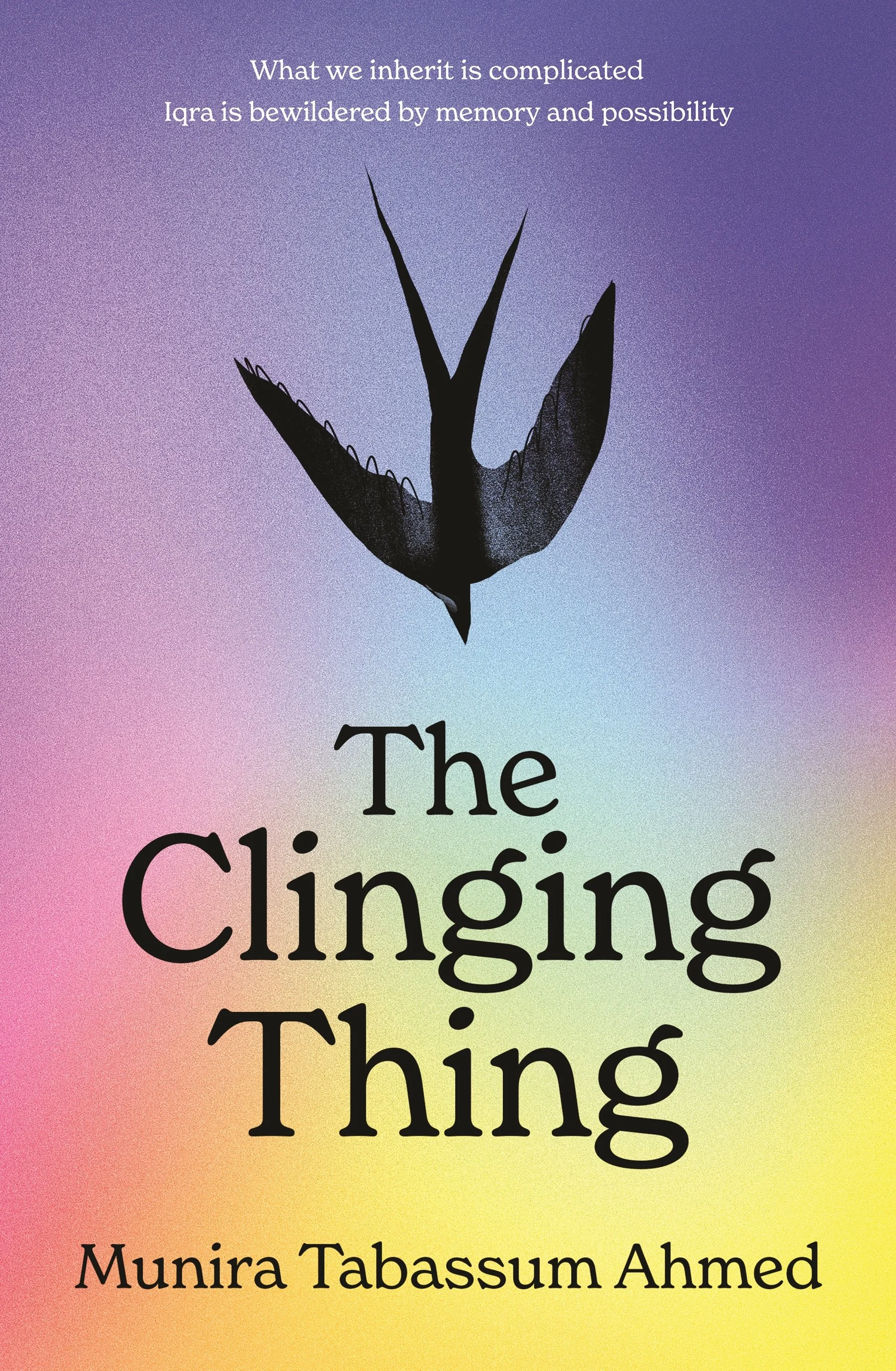
Book Review: The Clinging Thing by Munira Tabassum Ahmed
While Seam River no longer clung to the memory Iqra held of it, the water still echoed her name. It understands what she wishes to.
I had the privilege of reading, The Clinging Thing, and meeting with Sydney-based writer Munira Tabassum Ahmed to discuss her upcoming debut novel. The Clinging Thing follows a young woman, Iqra, through a single week of her life as she goes back to where it all started; a pilgrimage, if you will.
Munira is an Australian poet and writer whose work has previously been published in Adroit Journal, Red Room Poetry, Liminal, and Meanjin. As the recipient of the 2024 WestWords Accelerator, Munira was provided the opportunity to focus on the story that had been ruminating in the corners of her mind since 2021. Initially, she had a character group of four women, a clear arc for the storyline, and a central motive for the book; what became of it is an exploration of the complex ties between family, place, and identity.
The novel follows its protagonist, Iqra, as she returns to her hometown of Seam River to process a grief she has yet to experience. A place that holds too many memories for Iqra to make sense of. There, she stays with her mother, Hidaya, who knows that Iqra is hiding something. As Iqra returns home, she begins to remember and reconstruct her own path, as well as the paths of the women who came before her. This is not to say that she learns the answers to the never-ending list of questions we all have, as people, but rather begins to understand that having these questions may be the meaning she has been searching for all along.
As the story unfolds, the novel explores how a place can shape the way we perceive the world around us and hold our memories, sometimes holding on to them until we are ready. This connection between place and person runs throughout the novel, highlighting themes of memory, belonging, and transformation. Seam River offers Iqra – and the reader – a sense of grounding as we follow her through a transformative week.
By taking Iqra back to her hometown and showing the reader what could be an explosive week through a quiet lens, Munira brings forward one of the main themes throughout the novel: that clarity and meaning can be found in the smallest of moments.
Review Written By: Lillian O’Neill (she/her)
“We have these big moments that seem like they are and could be revelatory when the thing (moment) gets more surreal and more magical. But I think there is an inherent ambiguity in those big moments. Whereas I believe that moments of clarity and the kind of clarity that begets revelation and transcendence are in the small, mundane acts of care that the women in this book do for each other.” – Munira
Throughout the novel, Munira’s poetic writing style almost hides the depth of Iqra’s unknowing, or the depth to which Iqra thinks it reaches. In Munira’s own words, ‘there is a well of unknowing’ that the novel centres around. The root of Iqra’s unknowing can be found in a singular, finite question: what does she owe to the women that came before her? This question drives Iqra’s longing and uncertainty and forms the novel’s main argument. It is not about finding answers, but rather engaging with the act of questioning, revealing the heart of longing that defines Iqra’s story.
This longing is explored through Iqra’s remembering of what the women that came before her had sacrificed as she questions if she has fulfilled the path that was set for her. Munira highlights Iqra’s connection to the women in her family by implementing scattered dreamscapes throughout the novel, wherein Iqra begins to unpack this longing within her sub-conscious mind. ‘The density of allusion was quite important,’ Munira told me, as the characters themselves are ultimately a ‘convergence of the women that came before them.’
There is one aspect readers may find unsettling, this being the novel’s resistance to offering neat conclusions. This refusal is deliberate and reinforces the main argument – grappling with uncertainty is itself meaningful. By leaving key questions open, Munira pushes the readers to confront the same existential uncertainties as her protagonist. This uncertainty is the very point; the novel’s significance lies not in providing answers, but in encouraging the reader to reflect on their own obligations and longings, just as Iqra must. There is not always a neat ending to every story; some questions are not meant to be answered.
The Clinging Thing shines a light on the subtle moments we often overlook. I wholeheartedly recommend this book—not just for women, but for anyone who has searched for meaning in ordinary days, difficult days, and especially those days when answers remain elusive. Munira ultimately reminds us that ambiguity need not feel so unfamiliar.

Thank you to Munira for taking the time to meet with me to discuss her novel.