
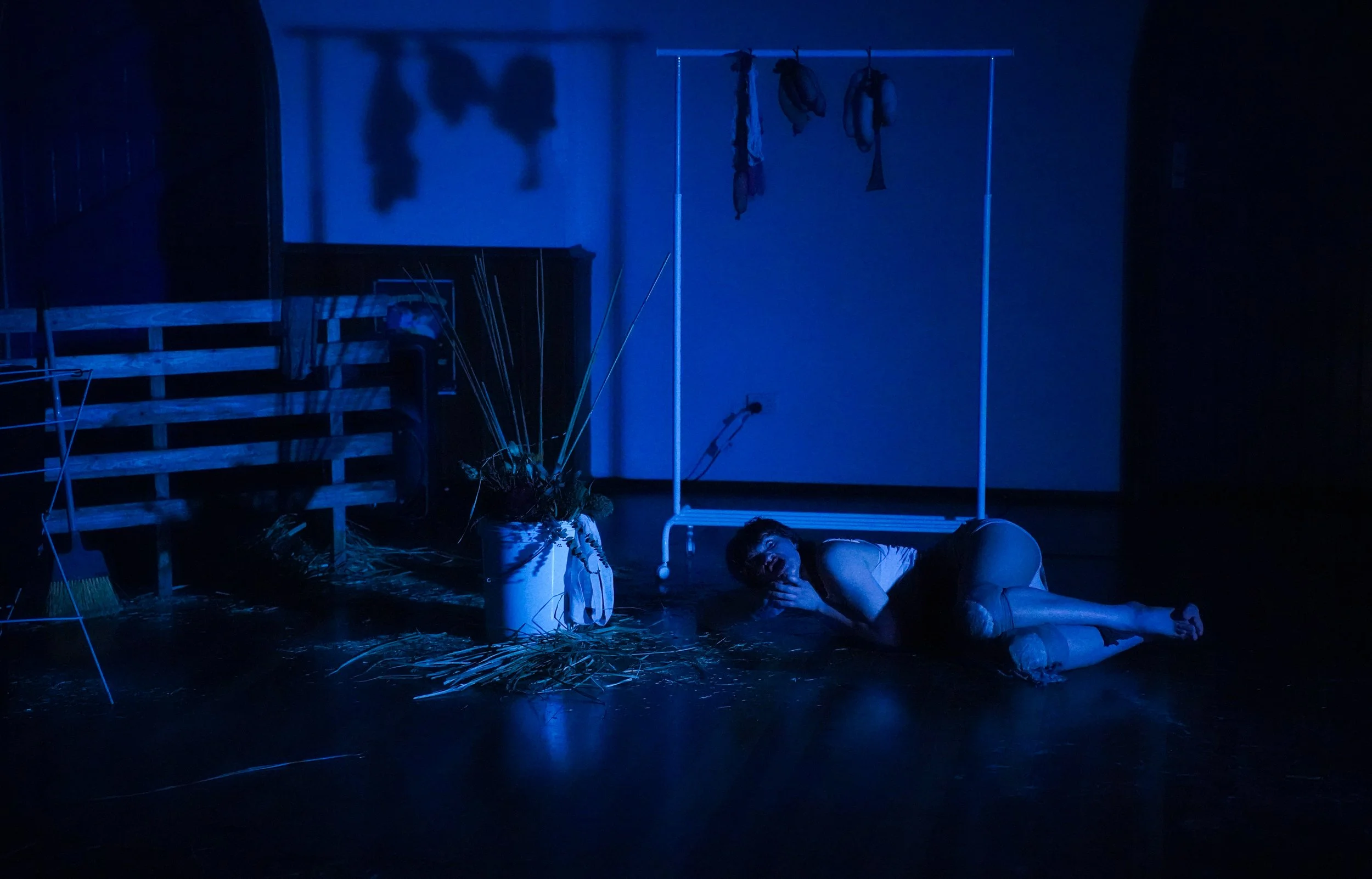
PIGSKIN, the latest work from neurodivergent, queer theatre-maker Lana Rosalea is a show that slates itself as for victims/survivors of sexual assault, by victim/suvivors. But what responsibilities come with making art about sexual violence, for an audience who might recognise their own experiences within it? For the team behind PIGSKIN, this question is both personal and political. I caught up with Rosalea to talk about these considerations, and how they influence the future of accessibility in theatre.
Images by Hayley Edgar
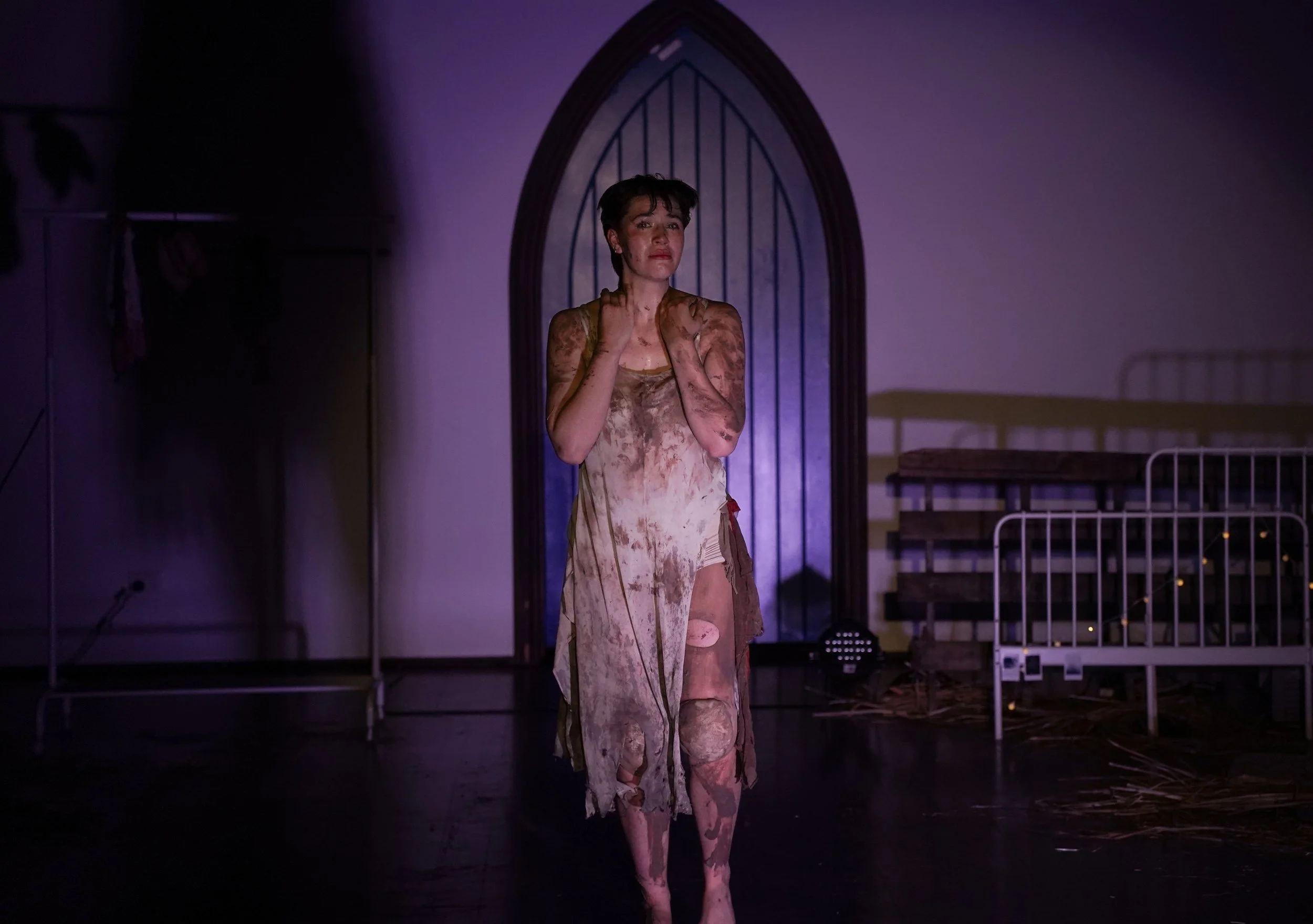
Performed alone by Rosalea, PIGSKIN is a show about Roe, a neurodivergent character who turns into a rotting pig after a ‘grey zone’ sexual assault. “We have tried to deliver the story through the dramaturgy of dissociation,” Rosalea tells me. “Cosima [the show's co-director] and I have been talking a lot about mind, body, and soul, and how they all feel so separated when you're going through a very traumatic event and you're still living your life as normal afterwards.”
On stage, this separation is embodied through three distinct elements: the body performs physical theatre, while the mind directs instructions to Roe and the audience, and the soul delivers the story.
The idea for PIGSKIN began long before it became a performance, first finding its feet as a collection of poems after Rosalea’s own experience with sexual violence, and taking several forms before becoming the experimental performance it is today. It was PIGSKIN’s dramaturg Oliver Ayres who suggested the show was in fact for victim survivors, and not just about them. “Oliver was reading through all my writing and was like, this is for victim survivors. You are not writing a show for the public. You are writing a show for them.” Rosalea recounts.
And thus this became the mission of PIGSKIN; to make a show in which victim survivors could see their experiences reflected, and connect with other survivors. This distinction informs the show's approach to performance. Rosalea and co-director Cosima Gilbert, who are both victim-survivors, were deliberate about avoiding reenactments of sexual assault. For Rosalea, it was important that the production did not become a space in which they had to repeatedly reproduce the experience itself.
Accessibility was a key consideration for Rosalea. Drawing on their own experience as a neurodivergent person, they were particularly conscious of ways in which they could make the PIGSKIN experience more comfortable for all audiences. As they point out in our conversation, sexual assault disproportionately affects disabled and neurodivergent people, so it was critical that the show allowed for multiple levels of engagement.
The use of individual headphones for each audience member is a distinct element of this consideration. Rosalea recounts finding inspiration in Ayres' use of headphones in his own performances: “The first time that I saw his show I'm Ready to Talk Now, it was such a heavy show, but it was still creating spaces wherein my neurodivergent brain could engage.” “You can really lock into one thing or lock into another thing,” Rosalea explains. “Having multiple access points into the work is safer for a lot of people's brains.”.
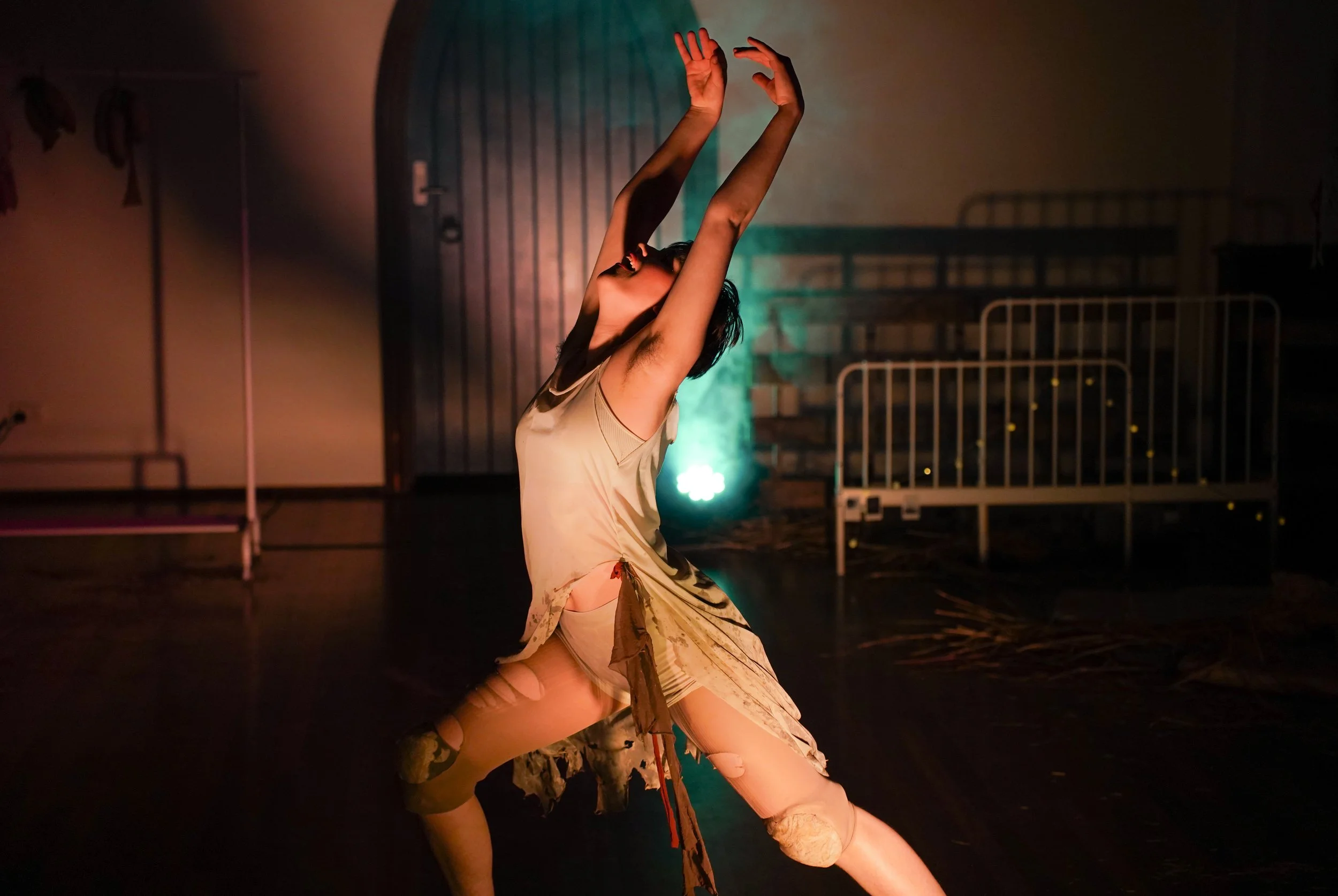
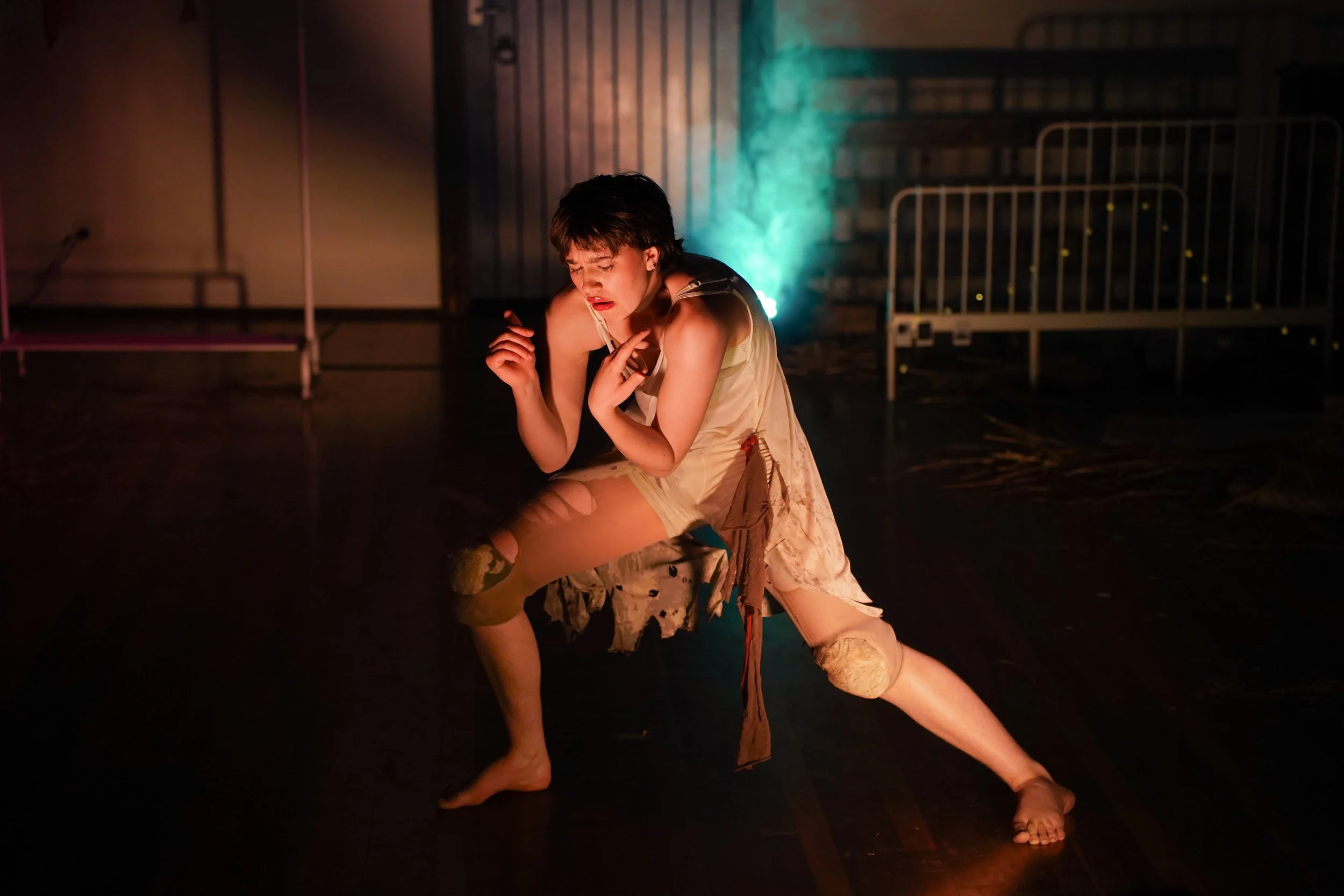
While avoiding direct recreation of incidents, the show does not try to be light hearted. Heavily informed by Butoh, a form of Japanese dance theatre originally referred to as ‘the dance of darkness’, Rosalea’s physical performance is passionately unsettling. During their decomposition, Roe stomps, drags, drools and contorts across the stage. Their distress is palpable. It is here that PIGSKIN’s multiple access points are best understood, for if the visual performance overwhelms, audiences can choose to close their eyes and immerse themselves in the audio, or alternatively, they may remove the headphones completely and engage only with the performance. While extending an invitation of exploration of sexual trauma, the option to separate mind, body and soul, is extended from creators to audience.
Headphones also provide a degree of preservation for Rosalea. Utilising a prerecorded monologue creates a separation for the performer, meaning they are not required to retell, or even listen to, the text of the show. “I don't think that I could say that out loud every night.” Rosalea tells me, highlighting the often overlooked mental and emotional fatigue required of performers.
PIGSKIN’s considerations of accessibility extend to every imaginable corner. Beanbags seats, selections of fidget toys, a dedicated quiet space, and even a registered psychologist on hand at each show are available to all attendees. “When I'm stressed out at a show, when I'm really feeling something at a show, I want to be able to clutch a blanket or move around,” Rosalea explains. “If I can't sit through watching PIGSKIN, without feeling so incredibly cared for […] then I don't particularly want to watch it or do it.”
This deep understanding of care and consideration for its audiences is a wonderfully unique comfort, and establishes an ambience perfectly suited to telling a story like PIGSKIN without creating unnecessary distress. Rosalea and their team’s dedication to accessibility was acknowledged with their winning of the Melbourne Fringe Festival’s Artform Shaker Award. Supported by Theatre Network Australia, the Artform Shaker Award is awarded to a production or work that champions leadership or innovation in equity, justice, inclusion and care, making the performing arts a better place to be.
Ultimately, PIGSKIN demonstrates that making art about sexual violence requires more than simply telling a story. It requires consideration of the people who might encounter it, and an understanding that audiences bring their own experiences, vulnerabilities and needs into the theatre. Through its deliberate approach to accessibility, PIGSKIN is a work that makes room for these experiences without demanding anything from its audience in return.
For Rosalea, accessibility not as an afterthought, but something fundamentally shaping the way theatre is made and experienced. PIGSKIN is a testament to what becomes possible when care is treated as an artistic responsibility, rather than an additional consideration. Perhaps this is the future of accessibility in theatre: not simply making space for more people to attend, but making sure they know they belong there.
If you have experienced sexual violence and require support, you can contact CASA House (The Royal Womens Hospital Centre Against Sexual Assault) 24/7 helpline on 1800 806 292
Performer/writer/co-director/co-producer: Lana Rosalea
Co-director/co-producer: Cosima Gilbert
Dramaturg/Access Consultant: Oliver Ayres
Sound designer: Alex Fimeri
Assistant Sound Designer: Brynn Jacka
Stage Manager: AJ Woodward
Assistant Stage Manager: Hatty Becker
Movement Choreographer: Matias Nunez
Set/Costume Designer: Kate Carrington
Voice actor (Boar): Rex Cameron
Voice actor (Pork): Aaron Wilson
Lighting Designer: Stuti Ghosh
Special thanks to: Andrew Thompson, Cole McKenna. Minami Yamasaki, Hugo Iser-Smith and Tim Wilson for help with lighting. Thank you to Joe Paradise Lui for its help with sound.
Photo credit: Diamond Media Creatives - Tylah Butler.