
Read Your Mind: In Dialogue with p0litrix
Aeva Milos (she/her)
Flashing across my phone, I read the following headlines:
During Perth’s Invasion Day rally, a 32-year-old man allegedly throws a homemade “fragment bomb” into a crowd of 2,500.
Student claiming RMIT is ‘complicit in genocide’ in social media post faces misconduct action.
New research by The Australia Institute estimates that the Australian government “provided $16.3 billion in subsidies to fossil fuel producers and major users in 2025-26” at the same time that Victoria saw bushfire conditions as destructive as the 2009 Black Saturday fires.
Social-media-streamed-genocide, climate catastrophe, transphobia and the instrumenalisation of people for profit are amongst the everyday doldrums of the society we are contained in, perform for, and disassociate from.
How exactly do we make sense of this reality and its disarticulation by our p0litical class?
Shadowing my interview with p0litrix is the desire for an answer, and for something better than this.
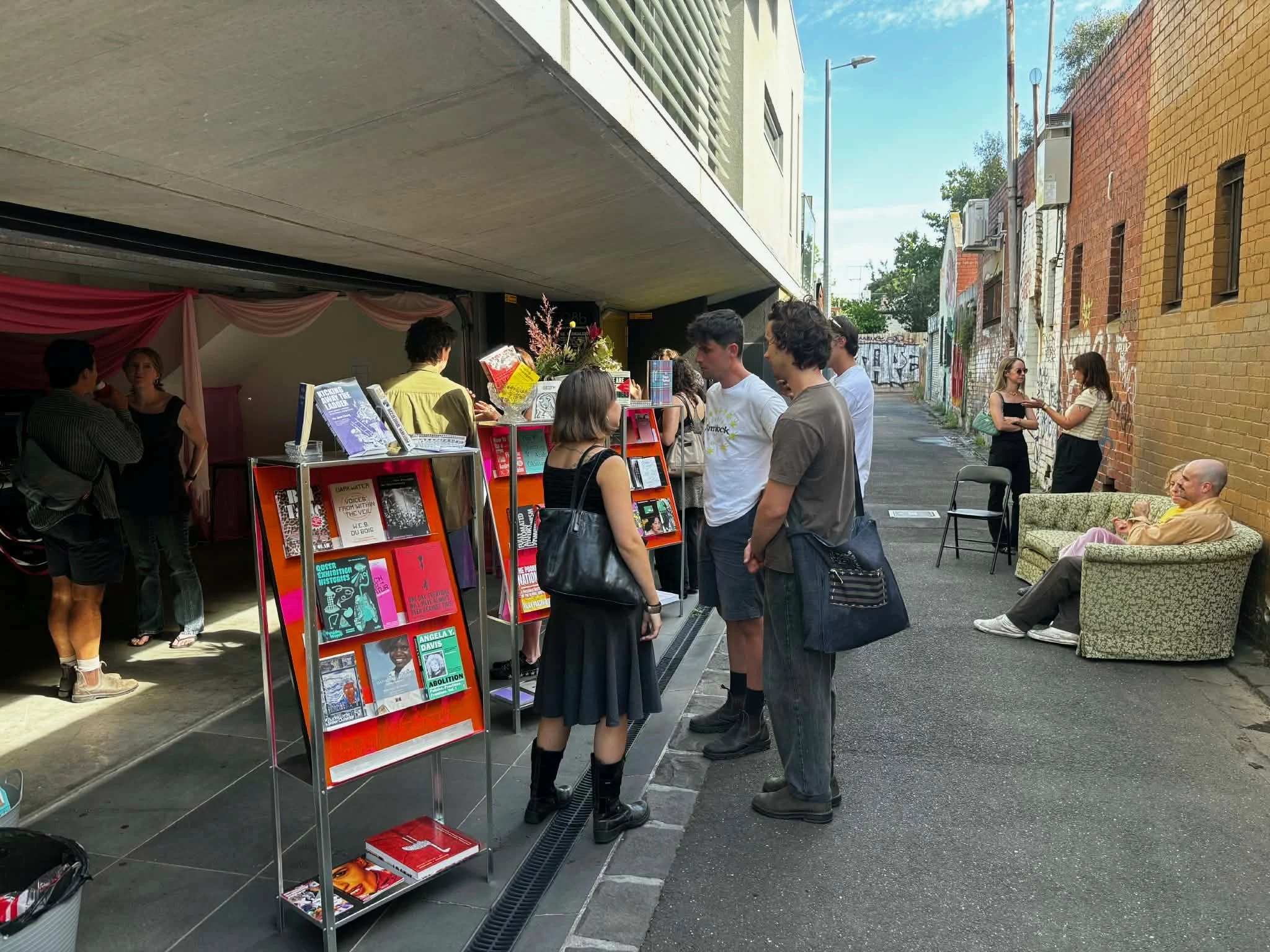
Open since April 2025, p0litirx is, first and foremost, a library curated and run by Julz, who turned the garage of her Naarm share-house into the library’s inaugural borrowing space. Filled with over 200 books, all bought, thrifted and distributed by Julz, p0litrix offers a thoughtful selection of accessible, radical, queer and intersectional literature. Whilst Julz is the person stacking the books, she is adamant I don’t make this about her: “I don’t think I have that much to say,” she reasons. “I want to transmit the already existing world-changing ideas”.
p0litrix is also a community, with borrowers keeping the stock fluid and responsive through reviews, and importantly, creating the atmosphere of change by showing up. The centring of community derives from p0litrix being a concept co-designed with Angel, a close friend of Julz’s who passed in 2025. Angel saw a future where strangers built a better world together.
I ask Julz about p0litrix’s origins. She responds:
“As I’ve navigated my desire for change and tried to develop a political praxis, I’ve really struggled to pair the convictions, passions and emotions that I have about how unequal or unjust things are, with the language to explain their cause or how to bring about a resolution. Then I realised the disillusionment is the point—thinking we are incapable of change is how the status quo is sustained. Access to the language of change is the contribution p0litrix seeks to make—we can’t challenge what we can’t name.”
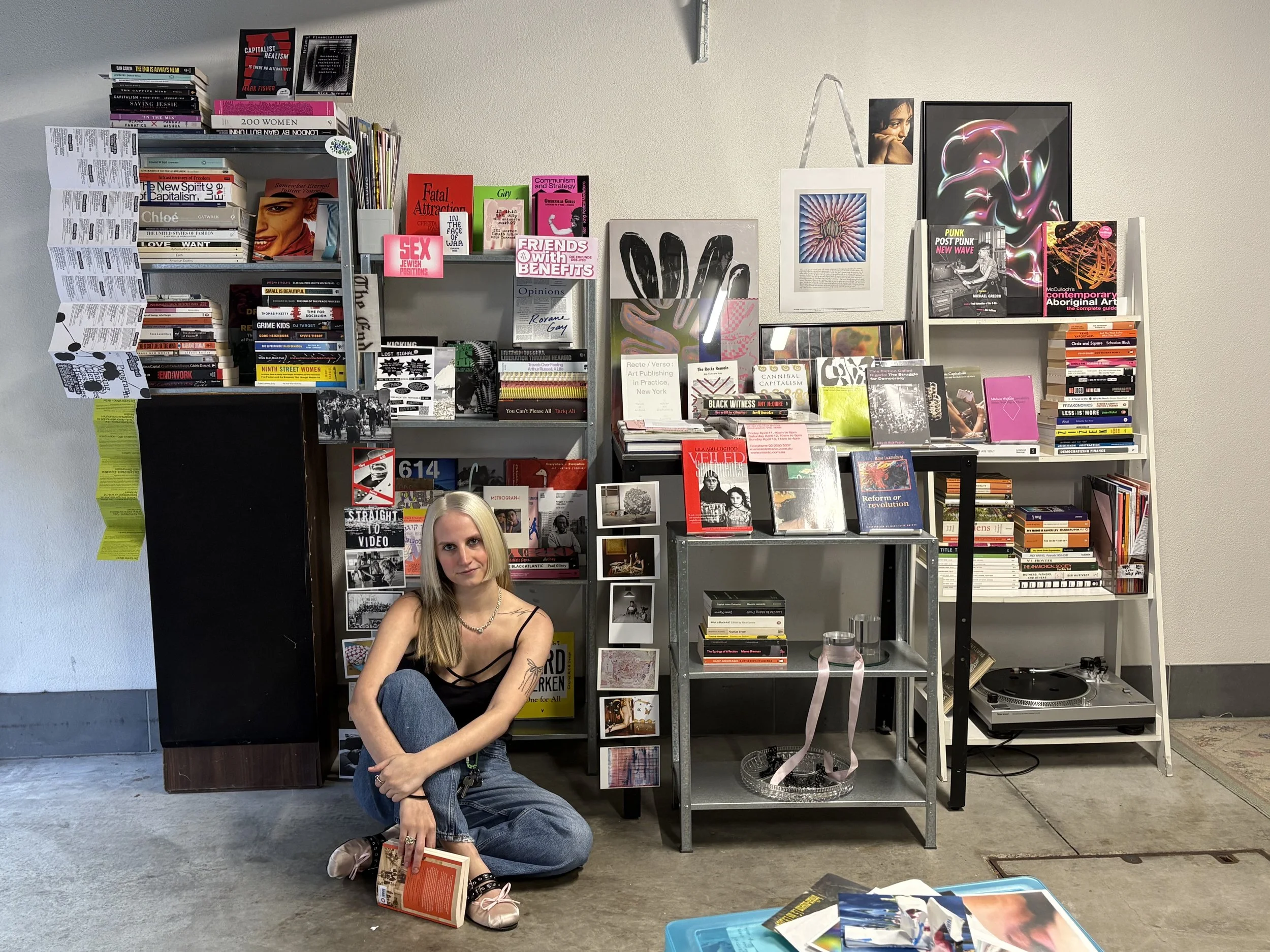
But diagnosis is incomplete. Julz posits: “A lot of the books I stock aren’t just diagnosing how we got here,” she says. Instead, p0litrix is motivated by the belief that a revolutionary future has already been thought up, in the writing of thinkers before us and among us.
Accessibility to these ideas and public critical discourse is the primary difference between knowing the tools exist to demand an alternative reality or remaining politically lost and disassociated without the means to understand why.
In short, “p0litrix is an invitation to learn and discover the better than this”. Whilst p0litrix focuses on disseminating information and provoking critical thinking, both of which are continuously suppressed by oppositional groups, change needs community—to imagine a different system with—and to imagine it working.
p0litrix’s 3rd pop-up, and 1st party was on Valentine’s Day, raising $1250 for Sisters Inside. Artists Loz, frontrightspeaker, R Rebeiro, hairclip, Margot Petrie, Ava McDermott, Alice Fault Kill and Hydra Pyxis, and the movie, Soundtrack to a Coup d’Etat, set the tone. The party was for “max borrowing and min haters”, inviting attendees to engage with and borrow from the p0litrix vault of countercultural texts, in a setting of transcendent music and community.
“When the library is full of people, it feels exciting. It feels almost like we’re flirting with change,” Julz says.
Julz and I discuss how direct action, mutual aid and moments of political agency such as protesting on the streets, studying political zines from previous movements or being moved by a documentary film are evidence of society’s desire and instinct for something better. Whilst editing this article, Dukkana, another local community library on Wurundjeri Woi Wurrung Country, hosted Readers and Writers Against Genocide’s afternoon of poetry and resistance with Palestinian poet Najwan Darwish, Palestinian author Micaela Sahhar and Goorie, Koori poet Evelyn Araluen. Such moments of sharing form kinship and are why spaces like Dukkana and p0litrix have a galvanising quality, rousing us from malaise or complacency, and reconstituting feelings of isolated disillusion into united action.
In reducing barriers to learning, p0litrix encourages acts of self-teaching and fills the gap left by (often) elitist academia by loaning readable yet radical information. There is no institutional obstacle—anyone can walk into p0litrix, for free, with the assurance that the books are a collective and mutual asset.
It’s safe to say that p0litrix is not an entirely physical space, even if it operates as one; p0litrix works off a system of knowledge based on communal exchange. It is a model championed by revolutionary thinkers, such as Tyson Yunkaporta, Audre Lorde, Angela Davis and bell hooks.
p0litrix working as the conduit for dissemination, community, learning and recognition is what makes it such an invigorating space to be in: it is not simply about borrowing books but enabling people to read works of resistance that they may otherwise have not, or could not, encounter in their day-to-day. In the act of reading, one can find a way to articulate, learn, adapt to and survive the extremities of our system, and maybe one day change it…
Books are available for loaning from Oddaný Gallery, during exhibition hours and scheduled bookstore drop-ins, (follow @p0litrix and @oddanygallery on Instagram for scheduling).
p0litrix’s current rotation of free-to-borrow titles includes:
§ Against Landlords – Nick Bano
§ Talkin’ Up to the White Woman – Aileen Moreton-Robinson
§ Black and Blue – Veronica Gorrie
§ Stone Butch Blues – Leslie Feinberg
§ Find me at the Jaffa Gate – Micaela Sahhar
§ Capital is Dead, is this Something Worse – McKenzie Wark
Images courtesy of p0litrix and Henry Creaser.