
HALF OF LIFE
TAKES PLACE IN THE DARK
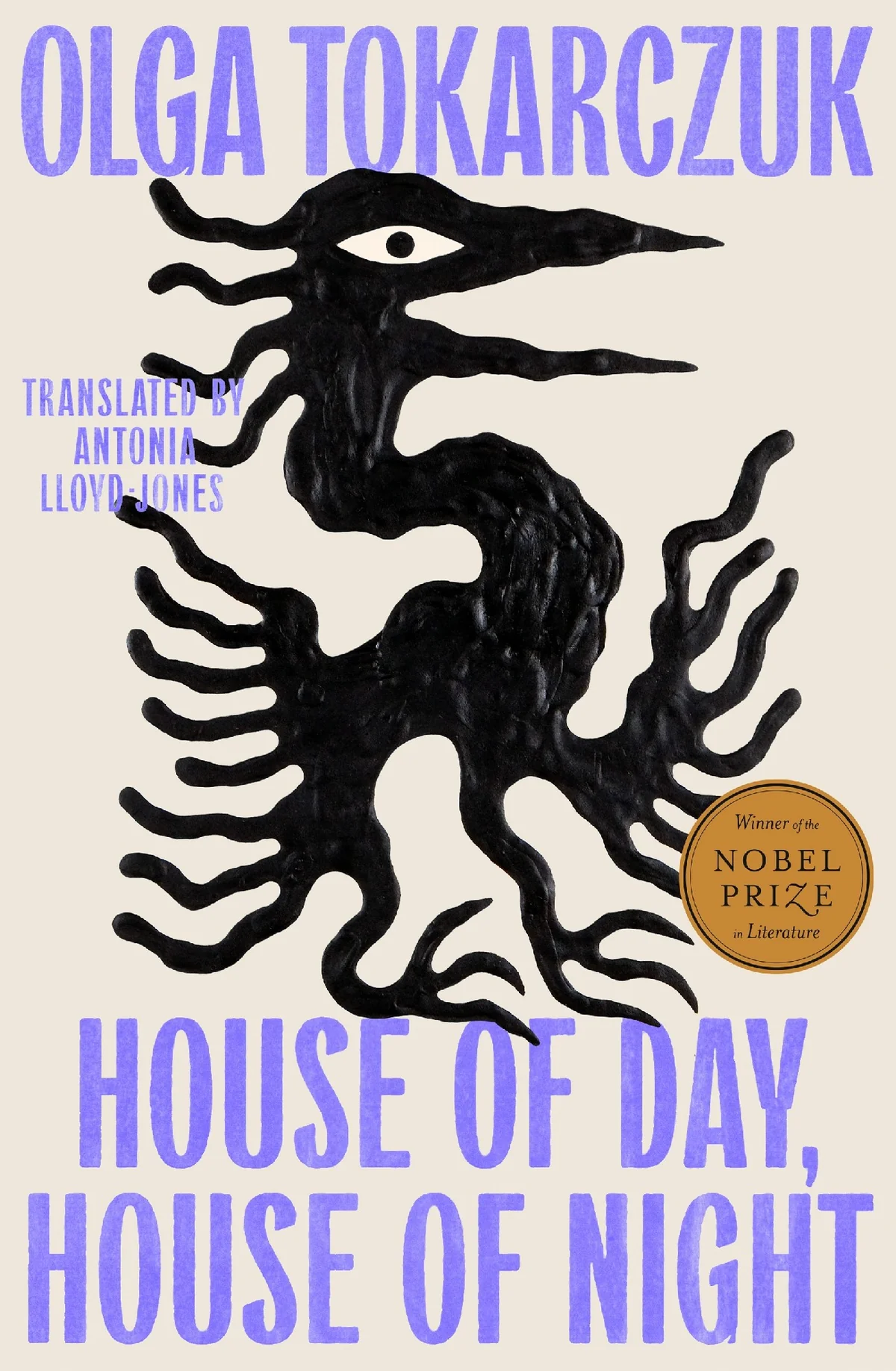
House of Day,
House of Night
Olga Tokarczuk is the recipient of the Nobel Prize in Literature and the International Booker Prize, among many other honours. She is the author of more than a dozen works of fiction, two collections of essays, and a children’s book; her work has been translated into more than fifty languages.
Antonia Lloyd-Jones has translated works by many of Poland’s leading contemporary novelists and reportage authors, as well as crime fiction, poetry and children’s books. Her translation of Drive Your Plow Over the Bones of the Dead by 2018 Nobel Prize laureate Olga Tokarczuk was shortlisted for the 2019 Man Booker International prize. For ten years she was a mentor for the Emerging Translators’ Mentorship Programme, and is a former co-chair of the UK Translators Association.
An extraordinary novel from Nobel Prize-winner Olga Tokarczuk, the renowned Polish author of Flights and Drive Your Plow Over the Bones of the Dead.
by Olga Tokarczuk
Translated by Antonia Lloyd-Jones
———
House of Day, House of Night Review
Book Review by Joella Marcus
“It’s an extraordinary feeling–to imagine that somewhere deep inside, you are someone completely different from the person you always thought you were. But it didn’t make me feel anxious, just relieved, finally free of a kind of weariness that used to permeate my life.
After a while this powerful feeling faded entirely, blotted out by concrete images: the door open to the hall, the dogs sleeping, the workmen who arrived at dawn and are putting up a stone wall.”
-- p.72I cannot summarise this novel but I'd suggest you live your life alongside it and let it linger and seep its way into the drum of your daily rhythms. You'll begin to notice how it sits with you, its presence a subtle reminder like an ear marked page. Marta will be there in the shadows, infrequently visiting as she does, her words if not true to you, something to chew on. I read it once cover to cover but each page many times over as I digested the story of a remote Polish village that held the expansive fragmented worlds of its few inhabitants. Stories, myths, gossip, anecdotes, philosophical reveries and even recipes populate this meandering tale, as narrative threads pull together a story of home, a house; one that is very much alive.
Originally published under in Wałbrzych, Poland under the title Dom dzienny, dom nocny by Wydawnictwo Literackie, 1998, the House of Day, House of Night is an immersive constellation novel by Olga Tokarczuk and translated by Antonia Lloyed-Jones. An ode to the real and legendary histories of Lower Silesia, Southern Poland, its anthology of stories, poems, prose and other short writing recover forgotten chapters of Eastern and Central Europe’s multilingual and multicultural history. The novel is set in derelict Nowa Ruda, close to the Czech border in a formerly German region that has, over the centuries, frequently changed national ownership, and forms part of Europe’s sanatorium belt. Tokarczuk explores identity, transformation, and the meaning of home as a physical and metaphorical space through landscapes and dreamscapes filled with the ghosts of past and present inhabitants. Crossing borders and blurring binaries suffuse the history of the landscape owned, lost and remade by a succession of lives.
In singular perspective, loosely following an anonymous narrator with her partner, R., a mosaic of relationships emerge within the town as the reader is adrift amongst tales of their lives, memories, dreams, and small-town folklore. As readers we begin in a dream, and are introduced to a fixture of the village, the elderly neighbour Marta. Her movements like that of the wind, constant yet enigmatic, her prose broken and filled with knowledge deeply embedded in the collective consciousness. As the novel progresses we share moments with the eccentrics and ‘misfits’; Marek Marek, a gender dysphoric Monk, the tale of Saint Kummernis, a lover found between a dream and a phonebook, villagers bound to the stars and the ordinary figures that exemplify the extraordinary feeling that the separation between dream and lived reality is divided only by belief.
“constancy really does exist, but way beyond my reach, while I’m like a stream, like the river in Nowa Ruda that keeps changing colour, and the only thing I can be sure of is that I’m flowing through a point in space and time, and I’m nothing more than the sum of the properties of that place and that time”
-- p.242Following the narrator who comes to understand herself through the woes and wisdom of others, Tokarczuk builds a narrative architecture that allows readers, alongside the narrator, to unearth the history of any place, no matter how big or small. The narrative anecdotes offer a peek into a larger universe as layered voices come to present universal truth.
As the landscape acts as a mirror for the self, Tokarczuk challenges readers to question their own quotidian banalities and how they relate to themselves in a world that is often no more than what we project into it. Stylistically, Tokarczuk writes in a simple and unadorned manner leaving the reader to grasp the heavier themes that hang off each word. The rhythmic pacing of her writing is somewhat cyclical and seasonal, urging you to slow down to the natural pacing of the landscape of Nowa Ruda. The effect is meditative as the natural pauses present knowledge that had been ringing in your ears long before you had reached the silence that could have delivered it to you. The interconnected structure of the novel, a central theme in and of itself as the fluidity of tales denotes how we are “nothing more than the sum of the properties of that place and that time”.
As the narrator completes the season, and Marta returns to her home across the river, readers are left suspended in thought sans resolution. A witty nod to the infinite and untethered nature of Tokarczuk's thematic network. Like the landscape as the book reaches its close, the turn of the seasons have stained the earth just as Tokarczuk has irrevocably tinged your mind.
———————————
Credits:
Thank you to Text Publishing for the copy.
Review by Joella Marcus.
House of Day, House of Night - Text Publishing
A woman settles in a remote Polish village. It has few inhabitants now, but it teems with the stories of its living and its dead. There’s the drunk Marek Marek, who discovers that he shares his body with a bird, and Franz Frost, whose nightmares come to him from a newly discovered planet. There’s the man whose death—with one leg on the Polish side, one on the Czech—was an international incident. And there are the Germans who still haunt a region that not long ago they called their own. From the founding of the town to the lives of its saints, these shards piece together not only a history but a cosmology.
Another brilliant ‘constellation novel’ in the mode of her International Booker Prize–winning Flights, House of Day, House of Night reminds us that the story of any place, no matter how humble, is boundless.
This edition was simultaneously published in the UK by Fitzcarraldo Editions, the US by Riverhead Books, and Australia and New Zealand by The Text Publishing Company, 2025. Cover art by Australian artist Minna Leunig.